Two people can disagree about a worksheet while believing they disagree about the whole education system. Before defending or rejecting a curriculum, identify the decision under discussion. Is it the learning goal, the example used to teach it, the pace, or the way achievement is judged?
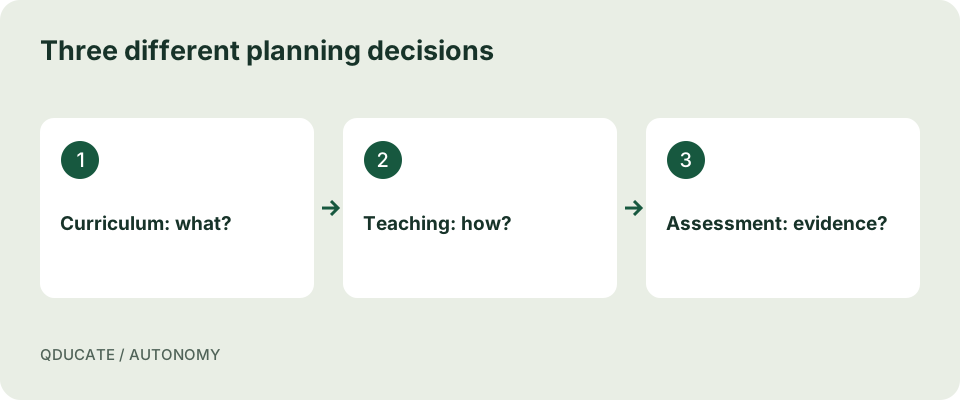
These questions connect, but they are not interchangeable.
Three questions to keep visible
Curriculum: What knowledge, understanding and skills are intended?
Teaching method: What will the teacher and learner do to develop them?
Assessment: What evidence will show what the learner understands and can do?
ACARA uses the distinction between the “what” of curriculum and the “how” of pedagogy in its discussion of education’s purposes. The Australian Curriculum is the appropriate starting point for inspecting its actual content, rather than relying on a promotional summary or a clip about another country.
Follow one goal through a lesson
Take a simple example: a learner should compare fractions. One teacher might begin with folded paper, another with a number line, and another with a worked numerical example. Those choices can address the same goal while creating different experiences.

Now choose the assessment. Asking the learner to copy a diagram checks something different from asking them to explain why three quarters is greater than two thirds. If the goal includes explanation, collect an explanation.
Make a planning card with three lines:
- Goal: compare two fractions and justify the comparison.
- Learning activity: construct both fractions on number lines of equal length.
- Evidence: compare a fresh pair and explain the reasoning without the original model.
This is an illustrative planning example, not a quotation from an official standard.
Locate the disagreement
If a lesson fails, describe the failure precisely. Was the assumed prior knowledge missing? Did the representation confuse the learner? Was the exercise so repetitive that it concealed a misunderstanding? Or was the intended learning itself inappropriate for the situation?
Each diagnosis suggests a different change. Replacing a worksheet may help with a poor explanation. It does not, by itself, settle a dispute about which knowledge belongs in a curriculum.
When discussing a named system, link to the exact document and identify its jurisdiction and version. Avoid treating a US debate as a description of an Australian classroom. Quote only the small passage needed, then explain what you think it means.
For the next step, use Choose a curriculum that fits your learner and Agree on the words before arguing about the answer.